
15 Jun A Lifetime on the Water: Brent Cushenbery’s California King Salmon Story
A Lifetime on the Water: Brent Cushenbery’s California King Salmon Story
More Than 50 Years of Family Tradition, Quality, and Stewardship
For Brent Cushenbery, commercial salmon fishing is more than a profession. It is a family legacy, a life spent on the water, and a deep connection to one of California’s most prized wild foods.
“My name is Brent Cushenbery and I am a second generation commercial salmon fisherman with over fifty years experience,” Brent shares.
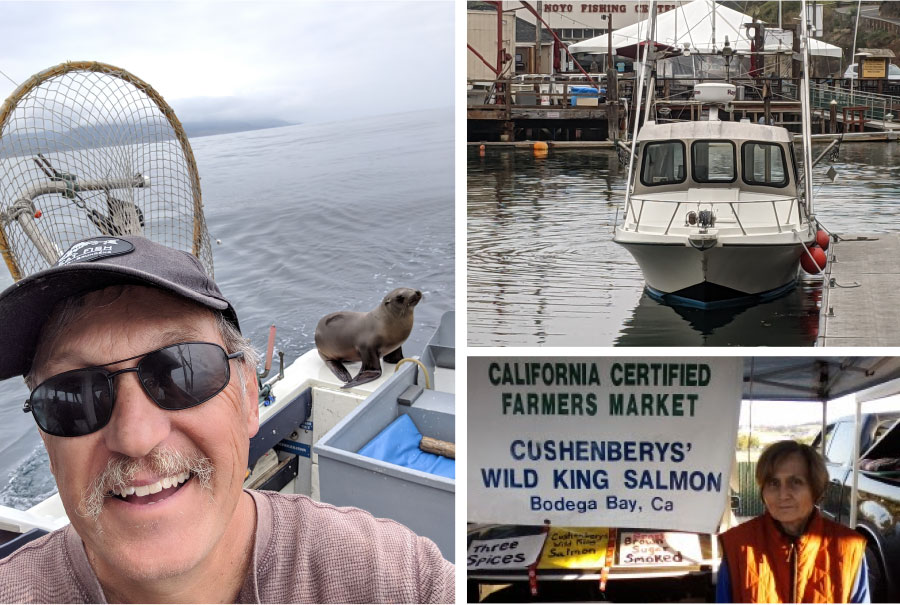
His earliest memories of salmon fishing began in childhood. His mother and father fished together, which Brent describes as unique. He often tagged along starting in grade school. Some days, he would take his mother’s place on the boat. There, he learned from his father how to navigate, fish, and read the ocean.
Those early days looked very different from fishing today. Brent remembers the family’s first boat, the F/V Circe. It had single hand cranks, only a compass for navigation, and a depth finder. After that first season, his father purchased a slightly larger boat, the F/V Aqua Taurus. It had two sets of hand cranks and radar.
But it was not the automated technology fishermen use today. Brent recalls that with those early radars, “you really had to know how to adjust the three knobs to read accurately what was out there in the fog.”
Navigation also relied on LORAN. This system gave fishermen numbers they matched to paper charts before GPS eventually replaced it.
A Boat Built for Quality
After a successful salmon season in 1979, Brent’s parents made a major decision. They went all in and had a boat built specifically for them.
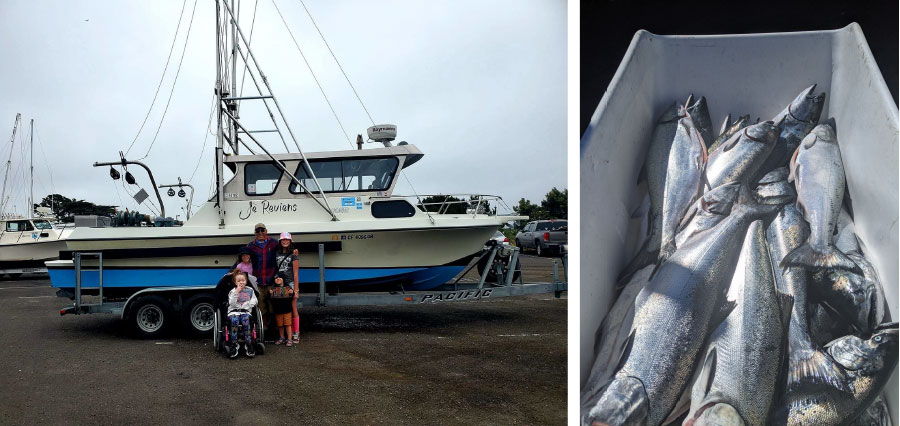
The F/V Je Reviens, French for “I shall return,” launched in 1980. Brent remembers the boat carrying over the same older electronics and radar from the Aqua Taurus because his parents had become skilled with that technology. But the Je Reviens also had something that made it stand apart: fully insulated, refrigerated fish holds on both the port and starboard sides, a feature few boats in the fleet had at the time.
For Brent’s family, quality was not an afterthought. It was part of the work from the moment a salmon came aboard. “My mother was the ‘queen of fish cleaning,’” Brent says. “She was a stickler for delivering a pristine product to the consumer.”
Her standards became part of the family’s reputation. Fresh, well-cared-for salmon became a signature of their offloads. Brent says his mother taught many fishermen how to properly clean and preserve their fish so customers at the dock and in restaurants received the best quality product possible. “She knew that customers would pay top dollar for a high quality product,” Brent says. “And she was correct.”
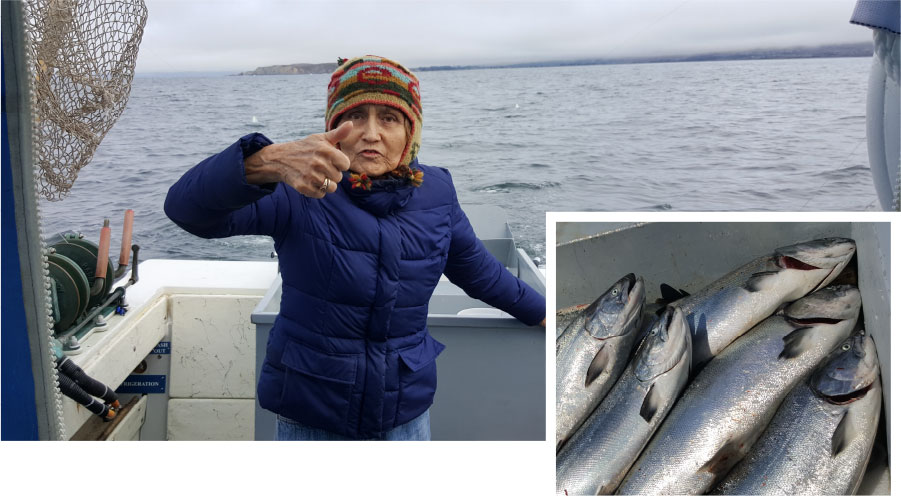
That care is still central to the value of California King salmon today. Every step matters — how the fish is caught, cleaned, chilled, handled, offloaded, and delivered. For fishermen like Brent, quality is a responsibility.
Why California King Salmon Is So Special
California King salmon is prized for its rich flavor, beautiful texture, and naturally healthy oils. Brent describes it simply and enthusiastically:
“What makes California troll caught wild King Salmon so special is that it is the BEST protein and full of omega-3 fatty acids and are considered a ‘Super Food.’” He also points to one of the simplest reasons people seek it out when it is available fresh: “In addition fresh salmon is just yummy!!”
For home cooks, chefs, markets, and seafood lovers, fresh California King salmon represents something seasonal and special. It is not available year-round, and when it returns to select markets, it carries with it the story of the fishermen, coastal communities, and careful handling behind each fish.
A Resilient Fishery
Brent has seen many changes during his more than 50 years in salmon fishing.
He has watched strong seasons, difficult seasons, closures, and shifts in the fleet. Through it all, he sees salmon as a resilient species. “Salmon are a resilient species,” he says, noting that they return to the river where they originated to spawn and give way to a new generation.
Over his lifetime, Brent has seen the cyclical nature of salmon returns. Low-return years can eventually lead to stronger seasons, while banner years can be followed by downturns. He also points to the importance of habitat work, including projects that improve spawning gravels and restore shallower, faster-moving waterways that salmon favor.
After three years of California salmon season closures due to low returns, Brent says this season feels encouraging, with good offloads from boats along the coast. He also supports careful management of the fishery.
“I am happy to see an overall quota on the fish to be taken by the fleet,” he says. “In this way only can we avoid ‘overfishing’ and truly remain a sustainable industry.”
That long view matters. Brent believes most fishermen understand the cyclical nature of salmon and do not want to sacrifice the future of the fishery by taking too many fish in a single season.
The Life of a Commercial Salmon Fisherman
Commercial salmon fishing is not easy work. It requires skill, patience, endurance, and a willingness to face difficult conditions.
“Commercial salmon fishers are a unique breed willing to tackle the toughest of conditions and one of the most dangerous occupations to catch this beautiful fish and deliver it to the marketplace,” Brent says. “Simply put, commercial salmon fishing gets in your blood and becomes a lifestyle.”
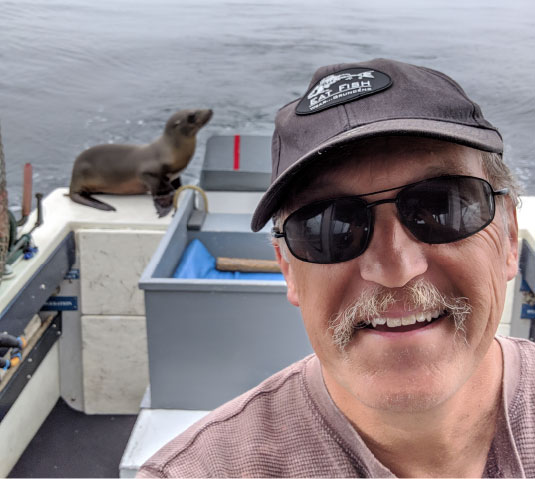
But the work also brings experiences few people on land ever get to witness. Brent describes seeing large schools of whales or porpoises, which often signal bait nearby — and with bait, salmon.
One of his most memorable stories happened while fishing off Morro Bay. A baby sea lion climbed onto the stern of his boat to escape a circling great white shark. Brent says the sea lion stayed with him for about half an hour and even fell asleep once it realized Brent was not a threat and the boat offered a safe place to rest.
It is those moments, along with the work, the water, the wildlife, and the rhythm of the season, that make the life hard to leave.
Looking Ahead
In more than five decades on the water, Brent has seen fishermen leave the industry, boats disappear from the fleet, and seasons close. But his outlook remains rooted in hope.
“There is one constant however and that is the salmon do and will survive,” he says. Brent feels blessed to have been part of California’s salmon fishing community for so many years. His hope is that fishermen can continue delivering the highest-quality fresh, troll-caught salmon to customers who appreciate it.
When people buy California King salmon, they are choosing more than a premium seafood product. They are supporting fishing families, coastal communities, careful fishery management, and generations of knowledge passed down on the water. For Brent Cushenbery, that legacy began on his parents’ boat. More than 50 years later, it continues every time fresh California King salmon is brought from the ocean to the people who look forward to it.
Source: Brent Cushenbery’s submitted fisherman story.