
22 Sep Dick Ogg: California King Salmon Fisherman Story
Dick Ogg on Curiosity, Care and the Spirit of California King Salmon
A hundred and fifty miles off the California coast, out of sight of land for days at a time, Dick Ogg is doing what he says he was always meant to do.
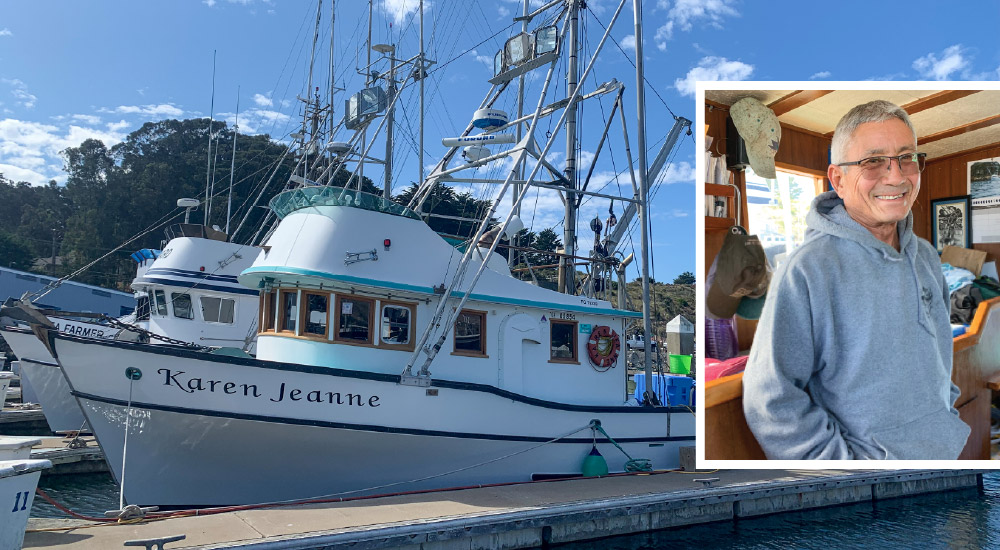
The captain of the F/V Karen Jeanne out of Bodega Bay fishes salmon, Dungeness crab, black cod and albacore. For Ogg, the work means more than simply making a living. He speaks about fishing in terms most people reserve for something closer to faith.
“It’s not just fishing,” he says. “It is an emotional, spiritual thing for me.” As he so passionately exclaims, “We are the stewards of the ocean.”
A Grandfather and a Lake
Ogg was born in Japan, placed in an orphanage and adopted by American parents who brought him to the United States.
His first memories of fishing belong to his grandfather, a member of the Ponca Tribe of Oklahoma. When Ogg was five or six years old, his grandfather started taking him to the lakes around the Osage country. His grandfather was a well-known Oklahoma bass fisherman. He was good enough that the host of the early television show The Flying Fisherman would land his plane, pick him up and fly him out to evaluate the bass in lakes across the region. He built his own bass boats and lures by hand. Ogg still has a number of them.
His grandfather would not let anyone photograph him. He believed that a picture could take a person’s spirit. “It never went away,” Ogg says of that lesson. “It was always something that was in my head.”
What his grandfather passed along was less a technique than a way of seeing. “It gave me an opportunity to see the perspective of the Native Americans around the land,” Ogg says, “and how they perceived what was nature.”
Stripers, Then the Open Ocean
By the early 1960s, the family was in Northern California. Ogg’s parents would drop him off along the South San Francisco shoreline.
There, he learned to fish for striped bass alongside the Portuguese fishermen who lived there. However, the open ocean was the real pull. When he came out to Sonoma County, he started spending his time on the coast.
The path to a commercial boat ran through a career on land.
Ogg worked at Sonoma State University for 31 years. Eventually, he became the supervising electrician in charge of everything from high-voltage systems down to 24-volt controls. With eight or nine employees under him, he earned his contractor’s license in 1980. In his late thirties, Ogg purchased his first boat and started fishing salmon.
Then he did the math.
“I soon realized that this was something that was potentially very economically feasible,” he says. About 28 years ago, he began fishing salmon and crab commercially. He banked vacation and comp time at the university. That allowed him to spend a week or two at sea at a time. The boats got bigger, and the opportunities grew.
By the time he retired from the university 20 years ago, he had already spent the last decade of his career figuring out how to return to the water full time.
Troubleshooting a Fishery
Ask Ogg how a supervising electrician becomes one of the more effective voices in California fisheries policy, and he’ll tell you the two jobs are closely connected.
“One of the worst things you can do as a troubleshooter or an electrician is to assume where the problem is,” he says. “Immediately when you do that, you’ve formed a concept or an idea, and it may not even be remotely close. Because you focused on that, you lose the ability to have an open mind.”
The same rule applies hundreds of miles offshore when something breaks and the crew looks to the captain.
“Take a step back. Let’s look at what the problem is and we’ll analyze it. We’re gonna figure it out.” That approach also applies in the meeting rooms where fishery decisions get made.
“I try to keep a very open mind, think about all the different situations, and not come in with a preconceived idea about how to fix it,” he says. “Look at the situation, analyze it, and be a problem solver — and find a positive direction to move forward.”
His negotiating style follows the same logic. He describes it as water moving over a rock. The goal is not to force anything open, but also not to stop moving. “I like to listen, understand, and then move smoothly through it,” he says. “The force of water is incredibly powerful.”
Finding a Voice
Fifteen years ago, Ogg says, no one who knew him would have believed he could speak in public. He didn’t believe it himself.
That changed when he became deeply involved in the industry. He realized that many issues affecting fishermen were going unspoken. A gear-recovery presentation around 2012 or 2013 became the starting point. Ogg filled in for a colleague who could not attend.
Then, in 2015, he began working with the California Dungeness Crab Fishing Gear Working Group. The organizers encouraged him to speak more often, and public speaking soon became part of his work.
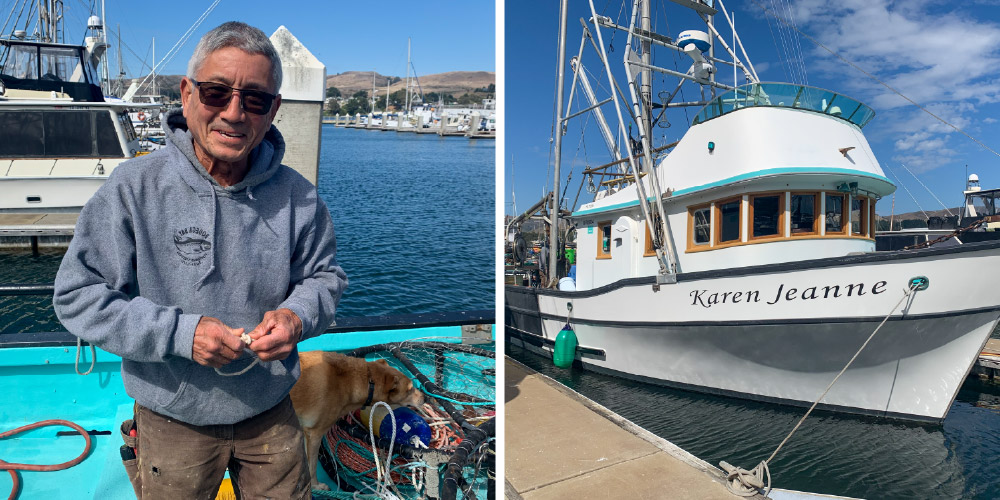
Today, he serves as vice president of the Pacific Coast Federation of Fishermen’s Associations, which represents the fleet from Crescent City to San Diego.He is also the Chairman of the California Salmon Council, a state self-help marketing program. Part of his job involves passing knowledge to the next generation of fishermen.
More importantly, he wants to inform the public. That starts with explaining how closely the commercial fleet is tracked. “The commercial industry has total accountability,” he says. “They know every single thing that’s landed, every single place that we fish.” Landings, locations and a range of other data go to the state. As a result, the state can closely manage a fishery like this one.
What Happens After the Hook
If Ogg’s philosophy sounds abstract, his handling of a salmon is anything but. Every step between the strike and the dock helps protect the quality of the fish.
“I am just horribly particular,” he says. “I drive everybody crazy. We try our best never to lose a scale.”
Once aboard, Ogg dispatches the fish immediately. He then cleans it within the first five or six minutes. Speed matters. The sooner he prepares the fish, the cleaner the flavor.
He takes pride in a careful process because quality and care matter most. Next, the salmon go into large temperature-controlled barrels of ocean water on deck. Each barrel has its own thermometer. Ogg can read the temperature from inside the wheelhouse. The fish stay carefully stored until the crew offloads them at the dock. When they leave his boat, the salmon are “absolutely pristine,” he says.
The Spirit of the Fish
Ask Ogg what makes California King salmon special, and the answer has little to do with the market.
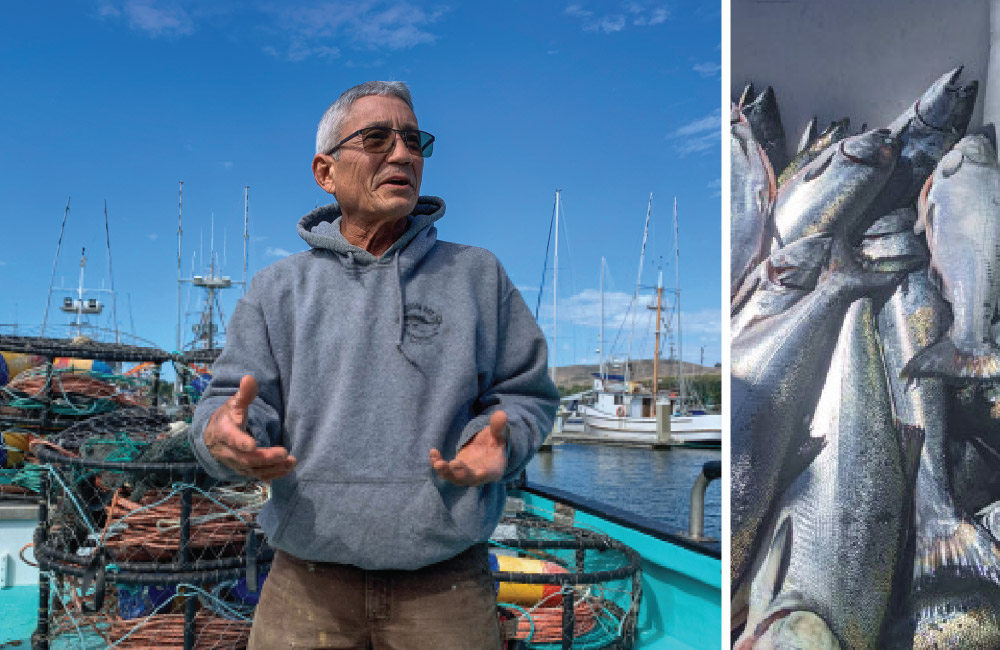
He has watched these fish straighten a number-six stainless steel hook. His crew gets upset when a big one gets off, but he never does. Instead, he prefers the 10- to 12-pound fish he can handle cleanly. He speaks about the 28- and 30-pound fish with something close to awe.
“The spirit behind the creature is just — I don’t even know how to explain it. You can see why the Native Americans worship the King salmon.”
“Think about the travel,” he says. “It gets born in the river, goes down the river, wanders all over the ocean, and then it fights its way all the way back hundreds of miles up to a river to spawn. That is just an incredible thing to think about.”
He continues, “For me, they’re spiritual. They are the essence of a drive to get to where they were born.” Ogg admits that taking a salmon has never been easy for him. Still, he finds meaning in knowing that the fish he catches are at the end of their journey.
The Stewards of the Ocean
Ogg admits he has always been shy about having his picture taken. Even so, he agreed to this profile. He did so for the same reason he agreed to start speaking in public a decade ago.
“My objective, in the long run, is to be sure that we are able to continue this fishery in the future,” he says. “The guys that are fishing with me, and the guys that are coming up behind them, are going to have an industry to continue, and be able to provide that sustainable resource to the public.” When asked what he most wants people to understand, he doesn’t hesitate.
“The fishermen are the stewards of the ocean. This is our livelihood. This is what we do. This is where we risk our lives,” he says. “We’re here to provide that sustainable resource to the public — and that belongs to the public. We’re the conduit.”
We’re grateful to Dick Ogg for taking the time to share his story, his perspective and the care he brings to his work.
His reflections on the challenges, responsibilities and rewards of fishing offer a meaningful look at the people behind California King Salmon. They also show the deep commitment fishermen bring to sustaining this resource for future generations.
To learn more about Dick and his life on the water, we also recommend watching this beautiful story published about him a few years ago: Dick Ogg: Fisherman — Every Second Breath.